GTA 6 Map Size: How Leonida Compares With Rockstar Worlds
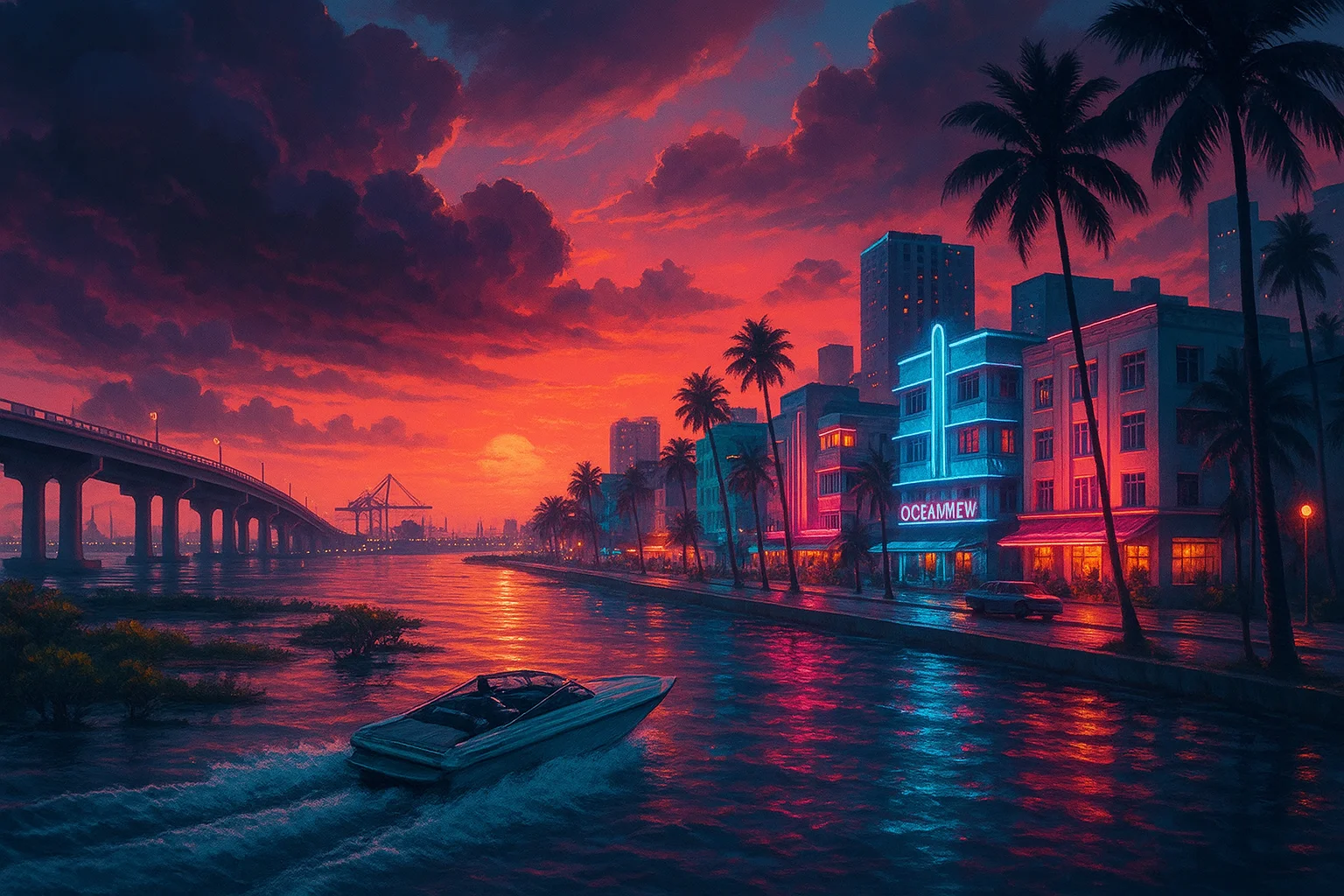
Grand Theft Auto VI’s world is being discussed in the largest possible terms, but the most useful way to read the new map-size claims is not as a race for a single square-kilometre number. Rockstar Games has not published Leonida’s total area in square kilometres or square miles. What has emerged instead is a set of relative comparisons tied to Rockstar North co-studio head Rob Nelson’s comments during press and creator preview coverage surrounding the August 27, 2026 Extended Look. According to accounts from invited creators, Nelson described the full GTA 6 map as roughly twice the size of Grand Theft Auto V’s world and around three times the size of Red Dead Redemption 2’s map. Those ratios are the central claims behind IGN’s comparison of GTA 6 with Rockstar’s previous open worlds, but they require careful reading: they are comparative statements, not a technical map specification published by Rockstar.
That distinction matters because a game world is more than its outline. Two maps with equal surface area can feel radically different depending on road layout, verticality, traffic, population, speed of travel, mission design, water access, interiors, and how often the game gives players reasons to leave its main city. GTA 6 is set in the fictional state of Leonida, home to Vice City and a broader collection of coastal, wetland, industrial, rural, and mountain locations. Rockstar’s official site currently identifies Vice City, Leonida Keys, Grassrivers, Port Gellhorn, Ambrosia, and Mount Kalaga as destinations across the state. That official place list is the most concrete evidence that Leonida is designed as a varied regional world rather than simply a larger version of one urban centre.
The immediate conclusion is clear even without converting the claims into a disputed land-area estimate: Rockstar is positioning Leonida beyond the scale of Los Santos and Blaine County in GTA 5, and beyond the frontier travelled in Red Dead Redemption 2. The more important question is what Rockstar intends to do with that expansion. GTA 5 made a dense Los Angeles-inspired city coexist with desert, mountains, coast, ocean floor, small towns, and a military base. Red Dead Redemption 2 used a slower pace, horseback travel, settlements, wilderness, wildlife, and long journeys to make its setting feel enormous. GTA 6 has the opportunity to combine a fast-moving modern crime sandbox with a geographically broader state. Whether it succeeds will be determined by density and purpose, not by a marketing-friendly multiplier alone.
What Has Actually Been Reported About GTA 6’s Map
The reported benchmark is straightforward. Rockstar North’s Rob Nelson reportedly told invited creator TGG that GTA 6’s map is around two times the size of GTA 5’s and around three times the size of Red Dead Redemption 2’s. RockstarIntel, which covered the creator’s report after the August 27 Extended Look, identified Nelson as Rockstar North’s Head of Development and co-studio head. Other coverage of the same preview repeated the broad two-times-GTA-5 and three-times-RDR2 comparison. Since the numbers come through preview accounts rather than a Rockstar technical document, they should be treated as reported developer comments, not as a final official measurement chart with an explained methodology.
A second reported detail concerns the city within that world. Brazilian creator Davy Jones said that Nelson told him Vice City alone is about twice the size of Los Santos in GTA 5, while areas outside the city are much larger. Coverage has repeated an additional claim that the outer areas are eleven times larger, but that statement is especially difficult to interpret without a precise definition of what counts as an “outside” area, whether water is included, and which borders are being compared. It is therefore best understood as an attributed preview statement rather than a figure players can independently verify before launch.
The ratios also create an apparent mathematical tension that should not be ignored. If GTA 6 is approximately twice GTA 5 and approximately three times Red Dead Redemption 2, then GTA 5 and Red Dead Redemption 2 cannot be assumed to have identical baseline measurements. That is not surprising. Community discussions often compare total explorable footprint, solid land, water, restricted regions, or the practical area available during normal play. Rockstar has not publicly established one standard calculation for every game in its catalogue. A “map size” result changes when an analyst counts ocean, inaccessible mountains, mission-only zones, or every piece of terrain visible on the pause-map screen. The responsible conclusion is that the relative claims establish GTA 6 as materially larger than both predecessors, while leaving its exact total area unconfirmed.
Rockstar’s own wording is expansive but qualitative. Trailer 1 described GTA 6 as taking players to Leonida, “home to the neon-soaked streets of Vice City and beyond,” and called it “the biggest, most immersive evolution of the Grand Theft Auto series yet.” The company’s August 27, 2026 post said the Extended Look was captured entirely from in-game footage on PlayStation 5 and likewise framed the game as the series’ biggest and most immersive evolution. Neither announcement gives a square-kilometre total. That omission is important: a precise online estimate should never be presented as a Rockstar-confirmed fact unless Rockstar itself supplies it.
“The biggest, most immersive evolution of the Grand Theft Auto series yet.”
Leonida Is a State, Not Just a New Vice City
The defining change from GTA 5 is that Rockstar’s official language does not frame GTA 6 as a visit to Vice City alone. It frames the game as a journey through Leonida, with Vice City as its central metropolis and several named destinations around it. This matters historically. The original Grand Theft Auto: Vice City concentrated on one stylised city, while GTA 5 built its world around Los Santos and the surrounding Blaine County. Leonida suggests a broader state model: a large city exists alongside islands, wetlands, industrial areas, a rural interior, and elevated terrain. Rockstar’s official “Only in Leonida” page explicitly invites players to tour destinations “across the sunshine state.”
Vice City is the clearest anchor. Rockstar describes it as part of Leonida’s “neon-soaked streets,” and the official character pages tie several figures to its businesses and music scene. Boobie Ike is described as having built an empire spanning real estate, a strip club, and a recording studio. Dre’Quan Priest is pursuing a role in the Vice City music scene with Only Raw Records. These are story and character details, not measurements, but they indicate why the city’s alleged expansion matters. A larger Vice City would not only mean more streets; it could provide more space for commercial districts, nightlife, property, entertainment, criminal networks, and the kinds of social scenes that Grand Theft Auto traditionally uses for satire.
The Leonida Keys offer a contrasting coastal environment. Rockstar identifies Jason Duval as having found work for local drug runners in the Keys after a stint in the Army, and describes Brian Heder as a veteran drug runner operating from a boat yard. The setting is consequently more than a scenic chain of islands in the official presentation: it is linked to smuggling, boats, waterside property, and the story’s criminal economy. A state map with a distinct Keys region could make water travel more meaningful than it was in GTA 5, where the Pacific Ocean was visually prominent and traversable but much of the core activity still clustered around land routes. That is an inference from Rockstar’s named setting and character material, not a confirmed feature list.
Grassrivers provides the strongest official indication of wetland territory. Rockstar has not published a detailed mechanical breakdown for the location, but placing Grassrivers alongside Vice City and the Keys establishes a different landscape category within Leonida. The choice also invites an obvious comparison with Red Dead Redemption 2, whose world used swamps and waterways as distinct spaces with their own atmosphere and travel rhythm. GTA 6’s setting is modern rather than historical, however, so its wetlands could support roads, airboats, fishing infrastructure, industrial edges, isolated houses, law-enforcement encounters, and criminal routes in ways that differ from Red Dead’s frontier. Those possibilities remain analysis, not confirmed content.
Port Gellhorn, Ambrosia, and Mount Kalaga broaden the picture further. Their official names alone do not tell players every activity or mission they will contain, so it would be wrong to invent detailed descriptions for them. But the sequence of destinations is meaningful. “Port” signals a separate named place from Vice City; Ambrosia appears as another stop on Rockstar’s Leonida tour; and Mount Kalaga establishes that the state includes a named mountain area. Taken together with the city, Keys, and Grassrivers, the list gives Leonida a much wider environmental range than a map made solely of downtown districts and suburbs.
- Vice City: Leonida’s neon-lit metropolis and the setting tied to Boobie Ike’s businesses and Dre’Quan’s music ambitions.
- Leonida Keys: a coastal region linked in Rockstar’s character material to Jason and Brian Heder.
- Grassrivers: an officially named destination that expands Leonida beyond the coast and city.
- Port Gellhorn: a separate named stop in Rockstar’s Leonida presentation.
- Ambrosia: another officially named destination associated with Raul Bautista’s page placement.
- Mount Kalaga: the named mountain destination on Rockstar’s Leonida page.
How GTA 6 Compares With Grand Theft Auto V
GTA 5 is the most useful comparison because it remains Rockstar’s modern Grand Theft Auto baseline. Rockstar called Los Santos and Blaine County its “largest open world yet - by far” before GTA 5 launched in 2013. The company stressed that the whole world was open from the beginning and described travel from mountain tops to Los Santos streets and down to the ocean floor. Rockstar also promoted GTA 5 through a three-protagonist structure built around Michael, Franklin, and Trevor, allowing mission design to shift across different parts of the world and different social settings.
That world established an influential Rockstar formula. Los Santos supplied the urban density: traffic, freeways, stores, mansions, industrial zones, beaches, nightlife, and the entertainment-industry satire that shaped the game’s tone. Blaine County supplied distance and contrast: desert highways, Sandy Shores, Grapeseed, forests, Mount Chiliad, military territory, and small-town spaces. The relationship between city and countryside was essential. GTA 5 did not feel like one continuous metropolis, and its large rural intervals made Los Santos seem like a destination rather than an endless urban texture. Rockstar’s own preview description explicitly placed the cultural and geographical variety of the setting at the centre of its pitch.
If Leonida is indeed about twice the size of GTA 5’s world, the headline implication is not simply a longer drive from one edge to another. It is that Rockstar may have substantially more room to make the spaces between major settlements matter. GTA 5’s outer regions were memorable, but the game’s most concentrated facilities, missions, and businesses often led players back to Los Santos. Leonida’s official destination list suggests Rockstar has planned more than one regional identity around Vice City. The critical design test will be whether Port Gellhorn, Ambrosia, the Keys, Grassrivers, and Mount Kalaga function as places players repeatedly inhabit, rather than landmarks crossed during a story mission and then rarely revisited.
The reported claim that Vice City alone is about twice the size of Los Santos points in the same direction. If accurate, the city would have to support a more varied internal geography than simply a scaled-up beach strip and downtown core. Bigger cities can become less legible when districts blur together, especially in a game where stolen cars and high-speed travel are core verbs. Conversely, a larger city can feel smaller than its dimensions if neighbourhoods are distinct, routes have character, and activities are placed with purpose. GTA 5’s Los Santos worked partly because familiar districts quickly became navigational anchors. GTA 6’s Vice City will need its own readable identity across any expanded footprint. The size statement remains a reported preview detail, not an official map measurement.
GTA 5 also offers the clearest warning against treating water as empty map space. Rockstar promoted the ability to reach the ocean floor, and water formed part of the game’s total world. Yet players’ everyday experience of the map was usually organised by roads, city blocks, mission destinations, and land-based businesses. Leonida’s coastal premise and official Keys location make water more central to GTA 6’s identity, but a large marine footprint will only change the game’s practical scale if Rockstar builds reasons to use it. The official material confirms the regional setting; it does not confirm a catalogue of water activities, underwater systems, or travel rules.
The Red Dead Redemption 2 Comparison Is About Density Too
Red Dead Redemption 2 is the other unavoidable benchmark, but it illustrates why raw area is only half the story. Its map is remembered for the transition between settlements, forests, mountains, plains, swamps, and rivers, and for the way the pace of horse travel made distance tangible. A player travelling through Red Dead Redemption 2 was often encouraged to observe the world rather than rush across it. The game’s scale came from geography, but also from the time required to move through it and from the environmental detail encountered during those journeys.
The reported three-times-RDR2 comparison therefore sets an extremely high expectation for Leonida. A modern Grand Theft Auto game has cars, aircraft, fast roads, and a more accelerated urban rhythm. Those systems make a large map easier to cross, which can paradoxically make it feel smaller. Rockstar has to compensate through route variety, traffic conditions, local activity, mission placement, and neighbourhood identities. A long highway can communicate statewide distance, but a highway without reasons to stop becomes transitional scenery. The broader Leonida concept suggests Rockstar understands that variety is part of scale: wetlands, islands, ports, rural zones, mountains, and a major city can create different travel behaviours within one state.
There is also a difference in what “density” means across the two series. Red Dead Redemption 2 could make a quiet road compelling through wildlife, random encounters, camps, weather, and the expectation that the natural world might produce a story. GTA 6 faces a modern equivalent. Vice City may need crowds, businesses, road incidents, pedestrians, social spaces, and reactive systems to feel alive, while the outer state needs its own reason to exist beyond providing scenic driving. Rockstar North’s Nelson told IGN that the studio looks critically at previous games to identify what it wanted to evolve, including areas limited by time, resources, technological capability, or earlier design choices. That comment does not promise a specific map mechanic, but it establishes that GTA 6 is being framed as an evolutionary project informed by Rockstar’s previous worlds.
“We look back at our previous games with a critical eye and see where we want to evolve.” — Rob Nelson, as quoted in coverage of IGN’s interview.
That context makes the GTA 6 versus Red Dead Redemption 2 comparison more interesting than a leaderboard. Red Dead Redemption 2 showed how much Rockstar could place in a world without making every location an urban attraction. GTA 6 can apply some of that environmental ambition to a contemporary setting, where a roadside business, a marina, a beach, a swamp, a port, or a rural property can all become part of a criminal sandbox. This is an analytical possibility based on Leonida’s officially named regional variety and Rockstar’s stated desire to evolve its prior work; it is not confirmation that each of those systems will appear in the final game.
A Brief Rockstar Open-World Timeline
Rockstar’s map history helps explain why Leonida is being treated as a major step. Earlier Grand Theft Auto games built their identity around stylised cities and memorable districts. Grand Theft Auto: Vice City turned its setting into a defining character, using a warm coastal atmosphere and a city built around a fictionalised version of Miami. Its official manual describes Vice City’s warm weather in a deliberately cynical tone, reflecting the series’ long-standing use of place as satire as well as geography.
Grand Theft Auto: San Andreas expanded that approach by moving beyond one city into a larger state-like arrangement of urban areas, countryside, and roads. The core design lesson was that distance and contrast could be as memorable as a city centre: leaving a metropolis, crossing country terrain, and arriving somewhere with a different cultural mood created a sense of journey. GTA 5 later refined that state-scale concept with Los Santos and Blaine County while taking advantage of far more advanced hardware. Rockstar’s 2013 preview called GTA 5’s open world its largest at the time and emphasised the ability to explore its varied cultural and geographical areas from the start.
Red Dead Redemption 2 then shifted the emphasis from urban satire to environmental presence. Its world was not about high-speed commuting; it was built around a different historical setting and a more deliberate traversal rhythm. In that sense, GTA 6 stands at the meeting point of Rockstar’s two modern open-world traditions: Grand Theft Auto’s city-first, vehicle-driven crime sandbox and Red Dead’s slower, highly environmental regional world. Leonida’s officially named mix of city, Keys, wetlands, port, rural destination, and mountain suggests that GTA 6 is attempting a modern state that borrows from both traditions without becoming either GTA 5 or Red Dead Redemption 2 again.
- Vice City: established the power of a single, strongly themed coastal city.
- San Andreas: demonstrated the appeal of travelling across contrasting urban and rural spaces.
- GTA 5: made Los Santos and Blaine County Rockstar’s largest Grand Theft Auto open world at its 2013 launch.
- Red Dead Redemption 2: became the modern comparison point for environmental detail and expansive regional travel.
- GTA 6: is reported to exceed both GTA 5 and Red Dead Redemption 2 in overall map scale while returning to a modern, Vice City-centred setting.
Why Square Kilometres Would Not Settle the Debate
Players understandably want an exact number, but even an official total would not answer every practical question. The first issue is boundaries. Does a measurement include every navigable stretch of water? Does it include high mountains that can be reached but contain little activity? Does it count mission areas, interiors, or off-map regions used in scripted sequences? Is an island’s coastline measured by the broad outline or by every inlet? Different answers can produce different totals while each remains technically defensible.
The second issue is access. Rockstar’s GTA 5 preview stressed that its entire world was open from the beginning, an important structural choice because it made the map a sandbox rather than a sequence of newly unlocked regions. Rockstar has not published an equivalent breakdown of GTA 6’s progression structure. It would be premature to claim that every part of Leonida is available immediately, locked behind story chapters, or limited by any particular system. Until Rockstar clarifies this, map size tells players nothing definitive about when they can reach the Keys, Grassrivers, Port Gellhorn, Ambrosia, or Mount Kalaga.
The third issue is vertical and interior space. A low-rise coastal county and a dense city with high-rise interiors can occupy very different kinds of game space even if their surface footprints are comparable. Rockstar’s official GTA 6 pages show a state with several kinds of location, but they do not provide an interior count or a technical density metric. Claims circulating online about exact quantities of enterable buildings, animations, missions, or other systems should not be folded into a map-size story unless Rockstar has confirmed them or the reporting clearly establishes their source and status. The safest reading is that Leonida’s geographic footprint is reported to be larger; its exact playable density is still something players will have to assess at launch.
The fourth issue is repetition. A map can be vast and still feel thin if too many areas serve only as scenery. Equally, a smaller map can remain compelling for years if players repeatedly return to its shops, races, businesses, social hubs, missions, and emergent events. GTA Online demonstrated the long-term value of revisiting Los Santos and Blaine County, which Rockstar describes as its live open world, full of mission givers, businesses, social hubs, properties, and other locations. GTA 6 has been officially announced as a single-player experience for PlayStation 5 and Xbox Series X|S on November 19, 2026; Rockstar has not, in the cited launch information, laid out a new online mode or its map plan.
What Leonida’s Scale Could Mean for Players
For players, the first implication is simple: Leonida should encourage route planning rather than the familiar GTA 5 habit of treating nearly every journey as a direct sprint between Los Santos and a countryside icon. If Vice City, the Keys, Grassrivers, Port Gellhorn, Ambrosia, and Mount Kalaga all become meaningful destinations, then the map can support distinct travel loops. A player might operate primarily in Vice City for one stretch of the story, take coastal routes and boats in the Keys for another, and encounter different terrain on the way to inland regions. Rockstar has confirmed the locations, but not the exact activities connected to each one, so those examples describe the potential of the map structure rather than announced gameplay.
The second implication concerns pacing. GTA 6’s story centres on Jason Duval and Lucia Caminos, whom Rockstar describes as becoming caught in a criminal conspiracy stretching across the state of Leonida after an easy score goes wrong. “Across the state” is narrative language, but it aligns with the design logic of a broader map: a criminal conspiracy can move players between different communities, business networks, landscapes, and kinds of criminal activity. Jason’s connection to the Keys and local drug runners, Lucia’s release from Leonida Penitentiary, Boobie Ike’s Vice City enterprises, and Raul Bautista’s bank-robbing crew provide official story anchors in several corners of that social world.
The third implication is expectation management. A map reportedly twice GTA 5’s size may sound as if it automatically guarantees twice as much worthwhile content. It does not. No map ratio can establish campaign length, mission quality, replay value, or the number of activities a player personally enjoys. Likewise, a three-times-RDR2 comparison does not mean three times the emotional impact of Red Dead’s landscape. Rockstar’s strongest task is to make Leonida’s regions feel authored rather than merely extensive. The company’s own marketing language focuses on immersion, while Nelson’s reported comments stress learning from earlier games. Those are ambitions, not proof of the final result.
The fourth implication is technical. Rockstar’s August 27 announcement specifies that the Extended Look was captured entirely from in-game footage on PlayStation 5, while the game is set to launch for PlayStation 5 and Xbox Series X|S on November 19, 2026. A state-scale map with a substantial city, coastline, wetlands, and other named regions puts pressure on streaming, traffic, lighting, draw distance, loading, and simulation. But it would be irresponsible to infer final frame-rate targets, resolution, performance modes, or platform differences from the map claim alone. Those details have not been provided in the Rockstar launch announcement cited here.
The Bottom Line: A Bigger World Needs Better Reasons to Explore
GTA 6’s reported size advantage over GTA 5 and Red Dead Redemption 2 is consequential because Rockstar’s previous worlds set such a high standard. GTA 5 offered the studio’s biggest Grand Theft Auto map at launch, connecting a major city to a varied county and ocean. Red Dead Redemption 2 demonstrated the power of a world whose environmental detail and slower travel made distance meaningful. Leonida now appears designed to extend both ideas into one modern fictional state. The official list of Vice City, Leonida Keys, Grassrivers, Port Gellhorn, Ambrosia, and Mount Kalaga gives that ambition a real geographic outline.
The reported comparisons should nevertheless remain in their proper category. They are strong evidence that GTA 6 is larger than Rockstar’s two most relevant predecessors, but they are not a substitute for a published official area figure, nor do they settle debates about land, water, density, interiors, or accessibility. The claim that Vice City is about twice the size of Los Santos is similarly notable but remains an attributed preview report. Players should resist turning either statement into a falsely exact technical specification.
What is confirmed is that Rockstar is taking GTA back to Vice City while expanding the premise into Leonida, a setting with multiple officially named regions. The Extended Look arrived on August 27, 2026, and Rockstar’s currently announced launch date is November 19, 2026 for PlayStation 5 and Xbox Series X|S. Between now and launch, the most useful new information would be not another speculative square-kilometre calculation, but clear official detail on how players travel, what they can do in each region, and how the state’s city, coast, wetlands, port, countryside, and mountains connect into one living world.
Comments · 2 comments
-
I’d be cautious with “twice GTA 5” and “three times RDR2” unless the article identifies a measurement method. Are these figures comparing total playable surface, land area only, or the full map bounds including water and inaccessible space?
-
That’s the key question. A useful comparison would ideally state the source map dimensions and apply the same method to each game; otherwise, the numbers are best read as a rough indication of scale rather than a precise, like-for-like ranking.
-