How GTA 6’s Map Size Compares to Previous Grand Theft Auto Games
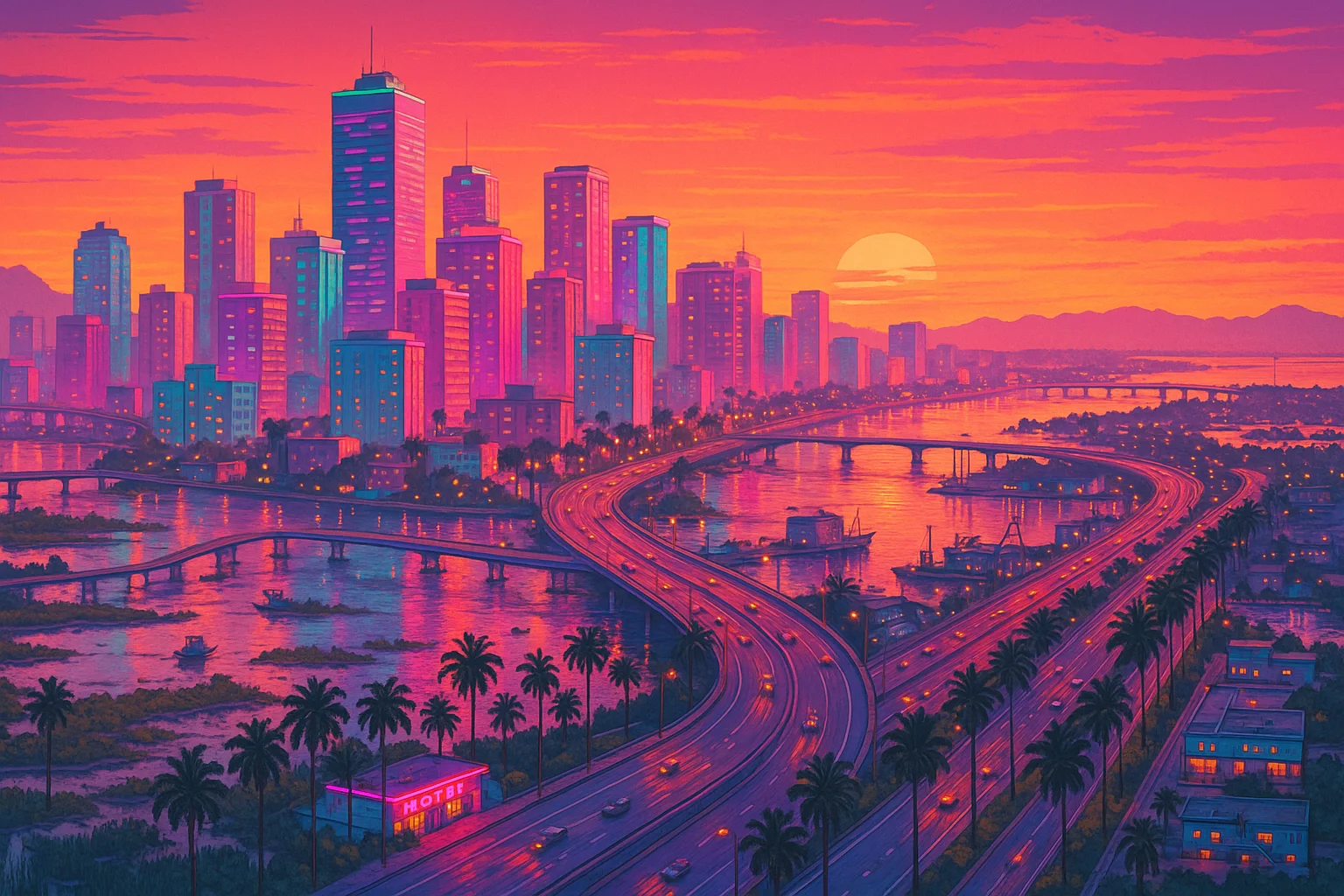
Grand Theft Auto has always sold a fantasy of freedom, but in practice that freedom is shaped by something much more concrete: the map. Every mainline 3D-era and HD-era entry has been judged not only by its missions or characters, but by the physical scale of the world Rockstar built around them. Liberty City in Grand Theft Auto III established the template. Vice City expanded it. San Andreas turned the series into a state-sized road trip. Grand Theft Auto IV traded some breadth for density, and Grand Theft Auto V delivered what Rockstar itself described in 2013 as its “largest open world yet - by far.” With Grand Theft Auto VI, Rockstar has confirmed a return to Vice City and the wider state of Leonida, but it has not published an official square-mile or square-kilometre figure for the map. That distinction matters when comparing GTA 6 to the games that came before it.
So the honest way to approach the question is simple: separate confirmed history from present-day estimation. For older games, there are a few useful official descriptions and some long-circulating measured figures from cartography and community research. For GTA 6, by contrast, the safest conclusion today, on July 3, 2026, is that Leonida appears broader in scope than GTA V’s Los Santos and Blaine County, yet its precise size remains unconfirmed by Rockstar. What is confirmed is the setting, several named regions, the game’s platform targets, and the fact that Rockstar has repeatedly framed the world as Vice City “and beyond.” Rockstar’s site currently identifies Vice City, Leonida Keys, Port Gellhorn, Ambrosia, Grassrivers, and Mount Kalaga National Park among the game’s locations, which already signals a much more varied statewide composition than a single urban core alone.
This article looks at how Rockstar’s maps evolved from GTA III through GTA V, what “bigger” has meant in different eras of the series, and where GTA 6 fits in based only on verifiable public information. Wherever GTA 6 numbers appear in community discussion, they should be read as estimates rather than official facts.
What Rockstar has officially confirmed about GTA 6’s world
The safest starting point is Rockstar’s own language. In the official Grand Theft Auto VI materials, Rockstar says players will explore “Vice City and beyond” in the state of Leonida. The May 6, 2025 Trailer 2 post describes Jason and Lucia getting pulled into “a conspiracy stretching across the state of Leonida,” while Rockstar’s GTA VI media pages and screenshot galleries identify multiple distinct regions beyond Vice City itself: Leonida Keys, Port Gellhorn, Ambrosia, Grassrivers, and Mount Kalaga National Park. That list is important because it confirms a statewide framing rather than a city-only one. ([rockstargames.com](https://www.rockstargames.com/es/newswire/article/3928aaa9471o3a/grand-theft-auto-vi-watch-trailer-2-now?pubDate=20250908&utm_source=openai))
Rockstar has also confirmed release information, though that timeline has changed over time. On May 2, 2025, Rockstar announced GTA VI was coming on May 26, 2026. Rockstar’s current Newswire archive and pre-order coverage now list the launch as November 19, 2026 for PlayStation 5 and Xbox Series X|S, with pre-orders having opened on June 25, 2026. For an article about the game’s map, that matters less as a gameplay detail than as a reminder that official information can shift, which is exactly why unverified map-size claims should be handled carefully. ([rockstargames.com](https://www.rockstargames.com/newswire/article/258aa538o412ok/grand-theft-auto-vi-is-now-coming-may-26-2026?pubDate=20260601&utm_source=openai))
What Rockstar has not confirmed is just as important. There is no official public map image showing the entire playable space. There is no official square mileage or landmass figure on Rockstar’s site. And there is no official ratio saying Leonida is a certain multiple of GTA V’s world. Even fan sites dedicated to GTA 6 map analysis generally note this plainly: the map’s dimensions are still estimates derived from trailers, screenshots, and reconstruction work, not from Rockstar-published measurements. ([leonidaatlas.com](https://www.leonidaatlas.com/news/gta6-map-size-leonida-vs-gta5))
That means any serious comparison must treat GTA 6 differently from the older games. We can discuss scope, region count, visual diversity, and likely design philosophy from official materials. But once someone claims a precise number for Leonida, they have stepped beyond confirmed fact.
Why map size matters in Grand Theft Auto
Map size in Grand Theft Auto has never been just a trivia point. It changes mission pacing, traffic rhythm, pursuit design, radio listening habits, and the psychological feel of travel. A compact city like GTA III’s Liberty City creates constant friction: short distances, sharp turns, frequent intersections, and rapid escalation. A broader state like San Andreas creates a very different emotional cadence, where freeway stretches, desert drives, and long transitions between cities become part of the experience. GTA V then fused those ideas into a world that mixed dense Los Santos districts with rural roads, mountains, coastline, and underwater space.
Rockstar itself has often marketed each successive world not only as larger, but as more varied. In 2002, Vice City level designer Aaron Garbut told GameSpot that Vice City’s play area was “almost twice as big as Liberty City” in GTA III and measured “over 4.25 million square meters.” In 2013, Rockstar called GTA V its “largest open world yet - by far - and spanning vastly diverse cultural and geographical areas.” Those two statements, separated by more than a decade, show the consistent design pitch: scale matters most when it unlocks contrast. ([gamespot.com](https://www.gamespot.com/articles/grand-theft-auto-vice-city-level-design-qanda/1100-2885365/))
That is the lens through which Leonida should be viewed. Even without an official area figure, the confirmed region names already suggest Rockstar is again pursuing contrast: an urban core, island chains, wetlands, a more industrial or rundown coastal zone, inland space, and a national park area. In other words, the question is not only whether GTA 6 is bigger than GTA V. It is also how that size is distributed, and whether it produces more meaningful variety per mile.
GTA III: the baseline that defined the modern series
Grand Theft Auto III, released in 2001, was the game that established the basic 3D GTA formula: a drivable open city built around multiple islands, mission hubs, pedestrian systems, radio stations, and the sensation that almost any street corner might become a story. By modern standards its Liberty City is relatively compact, but that compactness was central to its identity. The city felt dangerous and legible at the same time. Each borough-like island had a distinct atmosphere, and the confined geography made memorization part of mastery.
Rockstar does not appear to maintain a modern official square-meter figure for GTA III’s world on its current product pages, so comparisons usually rely on later developer commentary. The best verified relational data comes from Vice City’s development era: Aaron Garbut said Vice City was almost twice as big as GTA III’s Liberty City. Since he also gave Vice City’s play area as over 4.25 million square meters, that places GTA III’s rough playable area at a little over half of that by implication rather than as an explicit Rockstar-published standalone number. It is a useful reference point, but it should still be framed as an inference from an official comparison, not as a direct current Rockstar stat sheet. ([gamespot.com](https://www.gamespot.com/articles/grand-theft-auto-vice-city-level-design-qanda/1100-2885365/))
That matters because GTA III’s importance in the size debate is historical, not numerical. It created the expectation that a GTA city should feel like a convincing place rather than a sequence of arenas. Once that baseline existed, every sequel had to answer the same question differently: enlarge the playground, or enrich the density? Rockstar has spent two decades alternating between those priorities.
Vice City: bigger than GTA III, but more than a simple expansion
Grand Theft Auto: Vice City arrived in 2002 with a map that Rockstar’s Aaron Garbut described as “almost twice as big as Liberty City,” at “over 4.25 million square meters.” He also explained that the world was spread across the mainland, three smaller islands, and the large island of Ocean Beach, and that the team based the map closely on Miami while still bending reality around fun. That remains one of the clearest official size-related statements ever attached to a GTA world. ([gamespot.com](https://www.gamespot.com/articles/grand-theft-auto-vice-city-level-design-qanda/1100-2885365/))
Converting 4.25 million square meters gives a little over 4.25 square kilometres, or roughly 1.64 square miles. Even if players remember Vice City as far larger than that, the number illustrates a recurring GTA truth: density changes perception. Vice City felt expansive because it was thematically rich, visually distinctive, and structured around memorable districts, waterways, bridges, beaches, hotels, neon strips, mansions, and backstreets. The mood did as much work as the geometry.
That lesson is highly relevant to GTA 6 because Rockstar is returning to Vice City in a new continuity and at a radically different technical scale. The comparison many fans instinctively make is between the 2002 city and the 2026 one, but those versions serve different design goals. The earlier Vice City was an 80s-flavored crime playground built to maximize atmosphere inside a relatively compressed footprint. GTA VI’s Vice City, based on Rockstar’s materials, is only one component of Leonida, not the whole game world. So even if the city itself ends up far larger than its 2002 ancestor, the more meaningful comparison may be how the broader state balances urban spectacle with surrounding ecosystems.
San Andreas: the PS2-era leap from city to state
If Vice City refined the city-scale formula, Grand Theft Auto: San Andreas blew it open. Rockstar’s own description of the game still emphasizes that Carl Johnson’s journey takes him “across the entire state of San Andreas,” and a 2013 Rockstar Newswire post called it “the biggest GTA of the PS2 era.” Those descriptions reflect what players felt immediately in 2004: San Andreas was no longer one city with adjoining islands, but a network of major cities, countryside, desert, forests, and mountain roads, stitched together into a long-distance travel fantasy that none of the earlier games attempted. ([rockstargames.com](https://www.rockstargames.com/games/SANANDREAS?utm_source=openai))
Rockstar does not provide an official modern square-kilometre figure for San Andreas on its current main page, so most exact numbers seen online come from fan measurement projects and secondary databases rather than from a first-party technical sheet. Because of that, the most defensible claim is not a precise area value but the qualitative one Rockstar itself supports: San Andreas was the series’ largest 3D-era world and a major expansion in scope over Vice City. ([rockstargames.com](https://www.rockstargames.com/newswire/article/o349k55252497o/grand-theft-auto-san-andreas-mobile-coming-this-december.html?utm_source=openai))
Its influence on GTA 6 comparisons is huge. When fans say Leonida looks “state-sized,” they are really invoking the San Andreas template: multiple settlements, meaningful wilderness, long drives, and a world whose identity comes from regional transitions as much as landmark districts. GTA VI’s official region naming strongly supports that sort of statewide architecture. Vice City is one node; Leonida Keys points toward island travel; Grassrivers suggests swamp and wetland traversal; Mount Kalaga National Park implies an inland natural zone. Even without a map outline, the structure sounds closer in spirit to San Andreas than to GTA IV’s city-first model. ([rockstargames.com](https://www.rockstargames.com/VI/media/screenshots))
GTA IV: smaller footprint, higher urban intensity
Grand Theft Auto IV remains the counterexample that proves raw size is not everything. Released in 2008, it returned the series to Liberty City, but in a much more detailed and grounded form. The game’s world is often cited as being about 8 square kilometres by cartography researchers, a figure repeated by Video Game Cartography. That source is not Rockstar, so it should be treated as an external measured estimate rather than a first-party specification. Still, it broadly matches the common understanding of GTA IV: a smaller overall footprint than San Andreas, but with a denser and more vertically convincing urban simulation. ([videogamecartography.com](https://www.videogamecartography.com/2020/03/grand-theft-auto-iv-map.html))
GTA IV matters in a GTA 6 size discussion because it shows how player memory can diverge from simple map math. Many players experience Liberty City as “large” because it is layered, crowded, and psychologically intense. Driving there feels slower and more consequential than in a wide-open countryside map. The city’s texture, traffic, architecture, and borough identity make each mile carry more friction.
This is worth keeping in mind when looking at Leonida. A larger state on paper does not automatically mean a richer play space. If much of the world is transitional road or undeveloped wetland, the effective gameplay density could feel very different from a smaller but busier city. Conversely, if Rockstar has managed to fill each named Leonida region with bespoke activities, interiors, and route variety, then even a modest increase over GTA V could feel transformative. Without an official map and without hands-on access, the density question remains unresolved.
GTA V: Rockstar’s “largest open world yet - by far”
Grand Theft Auto V is still the clearest benchmark for GTA 6, because it is the previous mainline GTA and the one Rockstar explicitly marketed as its “largest open world yet - by far.” In Rockstar’s May 2, 2013 preview roundup, the company described Los Santos and Blaine County as a world “spanning vastly diverse cultural and geographical areas,” fully open from the beginning of the game. That official phrasing captures why GTA V became the modern yardstick: city districts, beaches, vineyards, desert, mountain ranges, and ocean space all coexisted inside one seamless map. ([rockstargames.com](https://www.rockstargames.com/newswire/article/o349k552514927/worldwide-grand-theft-auto-v-previews.html?utm_source=openai))
Rockstar did not attach a square-mile number to that statement, so the exact area most often cited for GTA V also comes from community measurement rather than from first-party documentation. Across fan cartography and comparison articles, the figure commonly used is around 49 square miles, or roughly 127 square kilometres, but that is still best described as a widely used estimate, not an official Rockstar spec. One reason the number persists is that it fits the scale players observe in traversal and the proportions visible in map data, but it remains extra-official all the same. ([pcgamecheck.com](https://pcgamecheck.com/blog/gta-6-map-size-leonida-vs-gta-5-2026?utm_source=openai))
Even so, GTA V gives us the best functional basis for Leonida comparison because Rockstar’s public materials set up similar design categories. Los Santos and Blaine County paired a dense metropolis with rural and wild spaces. GTA VI’s materials pair Vice City with Leonida Keys, Port Gellhorn, Ambrosia, Grassrivers, and Mount Kalaga National Park. In other words, Rockstar appears to be iterating on the same macro formula while changing the regional inspiration from Southern California to a fictionalized Florida and surrounding Americana. ([rockstargames.com](https://www.rockstargames.com/VI/media/screenshots))
The question, then, is whether GTA 6 merely matches GTA V’s size, modestly exceeds it, or dramatically surpasses it. Officially, we cannot yet answer that with a number. Structurally, however, the evidence points toward at least a similarly multi-biome ambition.
So how does Leonida compare right now?
Based on verified public information, the strongest statement we can make on July 3, 2026 is this: GTA 6’s world appears broader in scope than any previous officially revealed Rockstar setting before release, but its exact playable size has not been confirmed. The broad-scope claim comes from the combination of Vice City, multiple named surrounding regions, and Rockstar’s framing of a conspiracy that stretches “across the state of Leonida.” The lack of confirmation comes from the total absence of an official area figure or full map outline. ([rockstargames.com](https://www.rockstargames.com/es/newswire/article/3928aaa9471o3a/grand-theft-auto-vi-watch-trailer-2-now?pubDate=20250908&utm_source=openai))
Community projects have tried to fill that gap. Several current GTA 6 map-analysis sites compare reconstructed Leonida layouts to GTA V and often place GTA 6 at roughly two times GTA V’s size, sometimes more, sometimes less. But those same sites also openly note that Rockstar has not published an official figure and that their numbers are reconstructions. Even relatively careful fan analysis should therefore be treated as a moving estimate, not settled fact. ([leonidaatlas.com](https://www.leonidaatlas.com/news/gta6-map-size-leonida-vs-gta5?utm_source=openai))
That distinction is especially important because fan reconstructions are sensitive to assumptions: camera field of view in trailers, the scaling of roads and bridges, interpretation of shoreline curvature, whether visible backdrop mountains are playable or decorative, and how much of the implied state lies outside the accessible map. Small errors in any of those assumptions can produce very large differences in final area estimates.
What the official material does support is a likely increase in environmental diversity. Vice City suggests dense urban districts and nightlife. Leonida Keys points toward low-lying island routes and water-based traversal. Grassrivers implies swamp ecology. Mount Kalaga National Park suggests elevated or inland wilderness. Port Gellhorn and Ambrosia imply additional social and economic contrasts beyond the glamour of Vice City. That range alone may matter more to moment-to-moment play than the exact number of square miles. ([rockstargames.com](https://www.rockstargames.com/VI/media/screenshots))
The old maps versus the new one: the fairest comparison
If we compare only what can be responsibly stated, the historical ranking looks something like this. GTA III established the compact 3D-city baseline. Vice City officially expanded that by nearly twofold, to over 4.25 million square meters. San Andreas then became Rockstar’s biggest GTA world of the PS2 era, stretching across an entire state. GTA IV pulled back on overall footprint in exchange for dense urban simulation. GTA V became Rockstar’s largest open world yet, officially “by far,” while blending city, countryside, mountains, and ocean. GTA VI has officially revealed a statewide setting with multiple named regions, but no public area figure. ([gamespot.com](https://www.gamespot.com/articles/grand-theft-auto-vice-city-level-design-qanda/1100-2885365/))
That comparison is less flashy than viral social-media graphics, but it is more honest. It avoids the trap of pretending we know a final Leonida square-mile total when Rockstar has not told us. It also avoids overstating the precision of old-map numbers that were often measured after the fact rather than supplied in official technical documentation.
For readers who want a simple takeaway, here it is: GTA 6 looks positioned to continue the GTA V and San Andreas tradition of a multi-region, state-scale world rather than the GTA IV model of a more concentrated city map. But until Rockstar publishes a map or the final game ships and can be measured transparently, “larger than GTA V” is still not a confirmed fact. “Potentially larger, with more named regional variety” is the defensible phrasing.
Why players should care about density, not only distance
There is another reason the map-size conversation can become misleading: travel space and play space are not the same thing. A world can be physically larger yet offer less to do per minute. Equally, a smaller map can feel immense if it is thick with detail, enterable spaces, side systems, shortcuts, and competing activities. GTA IV is the classic example inside the series, but even GTA V demonstrates this internally: some zones feel memorable because of mission design and identity, not because they occupy huge portions of the map.
In GTA 6’s case, Rockstar’s official screenshots and region labels hint at a world built around contrast and spectacle rather than a single homogeneous sprawl. That is promising for density because different biomes often enable different interactions: boating, off-road driving, wildlife encounters, high-speed freeway runs, downtown escapes, and environmental set pieces. But again, we should stay disciplined: those possibilities are inferences from the revealed setting and visuals, not a confirmed feature checklist. ([rockstargames.com](https://www.rockstargames.com/VI/media/screenshots))
Players should therefore be cautious about reading giant speculative map overlays as proof of a better game. In Rockstar design, scale matters most when it improves rhythm. The best GTA maps alternate speed and congestion, rural openness and city pressure, danger and downtime. A world that is 20 percent larger but much smarter in how it layers activities could be more meaningful than one that is twice as large with little added substance. Rockstar’s own history suggests the studio understands that balance well.
What the return to Vice City changes
There is also a symbolic dimension to this comparison. Returning to Vice City invites direct memory against one of the series’ most iconic settings. But the name “Vice City” in GTA 6 does not mean a remake of the 2002 layout at a higher resolution. Rockstar’s current framing positions Vice City as the neon-soaked urban anchor of Leonida, not the totality of the map. That makes the old Vice City comparison culturally powerful but structurally incomplete. ([rockstargames.com](https://www.rockstargames.com/es/newswire/article/3928aaa9471o3a/grand-theft-auto-vi-watch-trailer-2-now?pubDate=20250908&utm_source=openai))
In practical terms, this likely changes how players relate to the city. In 2002, Vice City was the destination. In GTA 6, Vice City may be the hub from which the state opens outward. That shift mirrors the series’ broader evolution from city sandboxes to geographic ecosystems. It also means that one of GTA 6’s biggest map achievements may end up being not the city itself, but the roads, waterways, and social contrasts that connect it to the rest of Leonida.
That statewide design could also give Rockstar more room to stage different tones. Glamour and nightlife are already strongly associated with Vice City. The names Port Gellhorn, Ambrosia, Grassrivers, and Mount Kalaga National Park imply worlds with very different class textures, economies, hazards, and travel moods. Even before we know the precise scale, that kind of segmentation is one reason Leonida already feels more ambitious than a simple “bigger Vice City” pitch. ([rockstargames.com](https://www.rockstargames.com/VI/media/screenshots))
Bottom line: what is known, what is estimated, what to ignore
The cleanest conclusion is also the most useful one. Rockstar has officially confirmed that Grand Theft Auto VI takes place in Vice City and the wider state of Leonida, and its public materials name at least six regions or region labels: Vice City, Leonida Keys, Port Gellhorn, Ambrosia, Grassrivers, and Mount Kalaga National Park. Rockstar has not officially confirmed the total size of the playable map in square miles or square kilometres. ([rockstargames.com](https://www.rockstargames.com/VI/media/screenshots))
For previous games, the broad growth story is well supported: Vice City was officially said to be almost twice the size of GTA III’s Liberty City and to cover over 4.25 million square meters; San Andreas was Rockstar’s biggest GTA of the PS2 era; GTA IV emphasized dense urban simulation; GTA V was officially promoted as Rockstar’s largest open world yet, “by far.” Those facts give enough historical context to understand why Leonida is being watched so closely. ([gamespot.com](https://www.gamespot.com/articles/grand-theft-auto-vice-city-level-design-qanda/1100-2885365/))
What should players ignore? Any post, graphic, or video that presents a precise GTA 6 map-size number as if Rockstar has validated it. That does not mean all community research is worthless. Some of it is meticulous and clearly labeled. But it remains reconstruction, not confirmation. The responsible position for now is that Leonida is estimated by communities to be larger than GTA V, while the only officially verified reality is a statewide map centered on Vice City and multiple surrounding regions. ([leonidaatlas.com](https://www.leonidaatlas.com/news/gta6-map-size-leonida-vs-gta5?utm_source=openai))
And in the end, that may be enough. Grand Theft Auto’s best worlds are remembered less for their exact area values than for how they make movement feel: the first time a bridge opens a new district, the first desert highway stretch, the first mountain road at dusk, the first downtown skyline emerging over water. GTA 6’s map will be measured endlessly after launch on November 19, 2026. Until then, the honest comparison is not a fake certainty about square miles. It is the series history of ever-evolving world design, and the clear official signal that Leonida is Rockstar’s next attempt to make scale serve atmosphere, variety, and player freedom. ([rockstargames.com](https://www.rockstargames.com/newswire/article/5171972o3ak5oa/pre-order-grand-theft-auto-vi-on-june-25?utm_source=openai))
Comments · 2 comments
-
I’d want to see the methodology before taking any map-size comparison too seriously. Are they comparing total land area, full playable area including water, or just edge-to-edge dimensions, and what’s the source for the GTA 6 estimate beyond Rockstar’s official wording about Leonida?
-
That’s my question too. If the article only uses what Rockstar has officially confirmed, it would help to clearly separate confirmed details from fan measurements or trailer-based guesses, because those can make very different “size” comparisons.
-